
The mahi-mahi (Coryphaena hippurus), known in international waters as dorado, dolphinfish, or llampuga, is probably the most explosive, visually stunning, and rewarding pelagic fish in sportfishing from boat or kayak. Its fluorescent hues—blending electric yellows, emerald greens, and cobalt blues—, its acrobatic leaps out of the water when feeling the hook, and its blistering acceleration turn every single strike into a rush of pure adrenaline.
However, for the sport angler it has another characteristic that makes it even more fascinating: its strong seasonal and nomadic behavior. When summer matures and sea surface temperatures reach their annual peak, mahi-mahi invade our coasts in huge numbers. For several weeks the sea seems to boil with surface activity; but just as quickly as they arrive, with the first autumn storms and the cooling of the water, they vanish toward warmer or deeper pelagic waters until the following year.
Many anglers assume that finding mahi-mahi in the open ocean is a simple matter of luck or accumulating hours drifting aimlessly. The reality is very different. The appearances of mahi-mahi are not random: they respond to temperature gradients, converging ocean currents, drift lines accumulating plankton and small baitfish, and an instinctive attraction toward any floating structure or debris.
That is why finding a school of mahi-mahi on any given day is a great joy. But recording exactly where it occurred and under what environmental and marine conditions that encounter took place is what separates those who depend on chance from those who build a consistent catch pattern season after season. In this guide we will thoroughly break down the biology of this species, the most effective trolling and spinning techniques, and how to use CAPTA to turn an unforgettable day of fishing into tactical knowledge for next year.
Biology of a Pelagic Speedster: Rapid Growth and Extreme Voracity
To successfully fish for mahi-mahi it is essential to understand its life strategy. Unlike other predators such as the grouper, which have long lifespans and slow growth rates, the mahi-mahi lives in the fast lane. It is one of the fastest-growing animals on the planet: in just six to eight months of life it can exceed 50 centimeters in length and several kilos in weight, reaching sexual maturity in its first year of life.
This excessive growth requires an extremely high metabolic rate, forcing the mahi-mahi to feed almost continuously. Its diet is opportunistic and voracious: small horse mackerel, sardines, anchovies, flying fish, needlefish, squid, and even pelagic crustacean larvae are aggressively devoured if they cross its path.
Its anatomy is sculpted for speed at the surface and intermediate depths:
- Hydrodynamic body laterally compressed: Allows it to make instantaneous direction changes and cut through the water with virtually zero drag.
- Pronounced frontal crest in adult males: Mature males develop a nearly square, vertical forehead (commonly called "bulls"), while females maintain a more conical, rounded head.
- Forked caudal fin and continuous dorsal fin: Delivers explosive thrust capable of reaching top speeds exceeding 80 km/h (around 45-50 knots) in short bursts.
When a school of mahi-mahi detects food, it enters what anglers call a "feeding frenzy". In that state, they furiously attack almost any lure moving with speed and flash. But to take advantage of that voracity, you first have to find them in the vastness of the blue ocean.
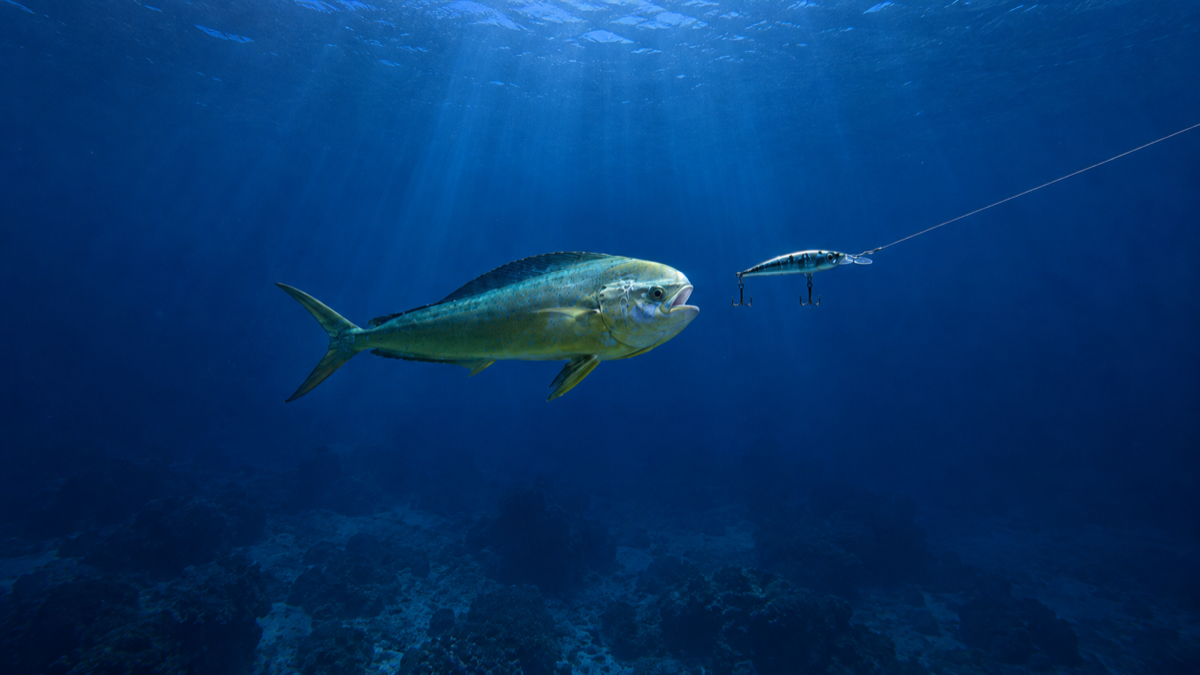
Reading the Sea's Signs: The Angler's Visual Radar
In bottom fishing we search for rocks, shoals, and steep drop-offs marked on nautical charts. But in pelagic fishing for mahi-mahi, most of the time we navigate over depths between 50 and over 300 meters where the seabed lacks usable relief for fish hunting in the top 5 to 10 meters of the water column.
In this scenario, the sea surface is our true nautical chart. Learning to interpret visible signs is what will lead us directly to the fish:
1. Seabird Activity (Gulls and Shearwaters)
Birds are the angler's best scouts. If you see birds circling, flapping nervously, or dive-bombing the water, have no doubt: underneath there are predators pushing baitfish to the surface. If the birds fly low and glide in a straight line, they are usually pacing a school moving at high cruising speed.
2. Current Lines and Thermal Seams (Rip Lines)
When two water masses of different temperature, density, or salinity meet, they form a visible boundary on the surface: a line where the water changes color (for example, from dark blue to bottle green), often accompanied by a strip of foam, floating debris, or gentle ripple lines. These seams concentrate nutrients, plankton, and fry. For mahi-mahi, they are veritable hunting highways.
3. Changes in Sea Surface Temperature (SST)
Mahi-mahi are extraordinarily sensitive to the ocean thermometer. In temperate waters they typically activate when water exceeds 21 °C, finding their optimum range between 23 °C and 27 °C. A sudden drop of two degrees caused by a storm can push the school down or cause them to migrate offshore into warmer waters.
The Phenomenon of Floating Debris: The Magic of Fish Aggregation Devices (FADs)
Any angler who has chased dorado knows their most famous behavioral trait: positive thigmotropism, that is, their instinctive attraction to any object drifting in open water.
A tree trunk washed away after a storm, a detached marker buoy, a Styrofoam cooler, an abandoned rope, or even a dense patch of sargassum weed becomes an oasis of life in the middle of a blue desert. First, small barnacles and mollusks attach; then small crabs and juvenile fish arrive seeking shelter; and finally large predators appear, such as mahi-mahi, yellowtail or amberjack, and bonitos.
In fact, in many coastal regions traditional artificial FADs (palm fronds tied to a rope anchored with stones in deep water) have long been deployed specifically to hold schools.
Golden Rule of Navigation: Whenever you spot a floating object adrift, no matter how small, reduce speed and approach with the engine throttled back, tracing concentric circles about 30-40 meters away. More than 70% of the time, one or more mahi-mahi will be patrolling in its shadow.
Inshore and Offshore Trolling: How to Locate the Schools
Trolling is the premier technique for prospecting large expanses of water until getting the first strike. It allows us to cover miles of coastal shelf or open ocean while presenting lures at varied distances and depths.
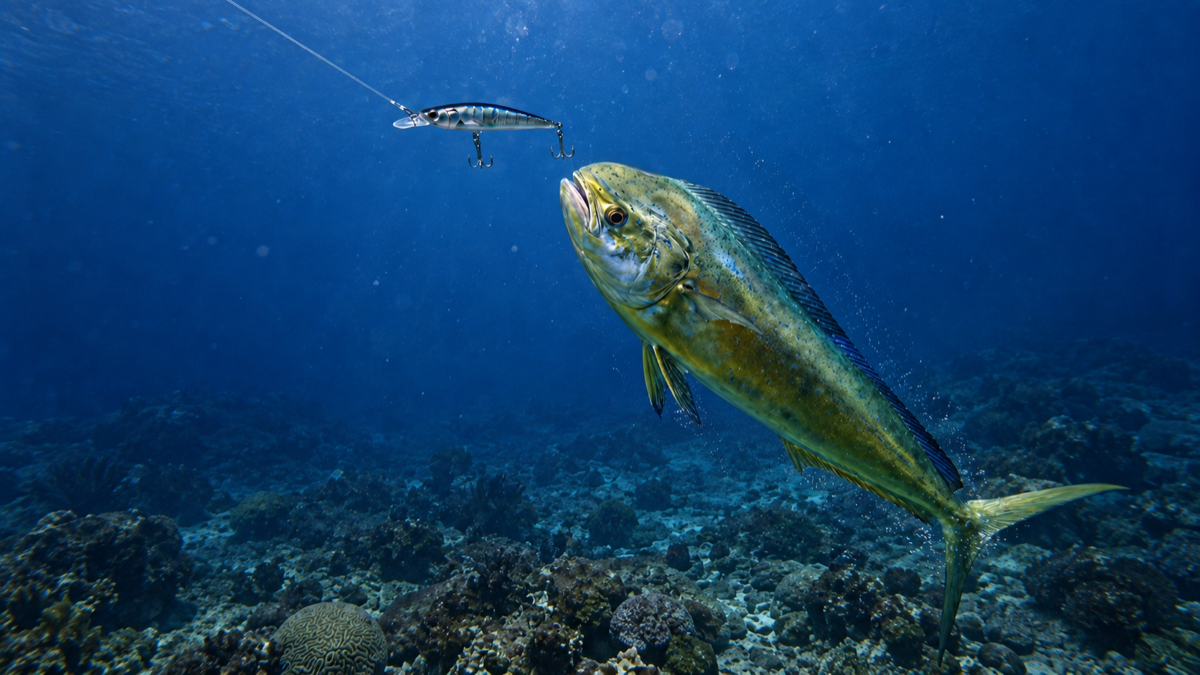
Recommended Trolling Speed
Unlike bottom slow-trolling with live horse mackerel for John Dory —where we crawl along at 1 or 1.5 knots—, for mahi-mahi we need brisk cruising speed:
- With surface lures and feather jigs: Between 5.5 and 7.5 knots. The mahi-mahi is a visual predator stimulated by speed and the white prop wash.
- With bibbed minnows: Between 4.0 and 5.5 knots, ensuring the lure dives between 1 and 2.5 meters without blowing out or skipping uncontrollably.
Boat Line Spread Setup
A common mistake is setting all lines at identical distances, causing tangles during turns. A classic, highly effective four-line spread consists of:
- Two short lines (inside the prop wash): About 15-20 meters behind the transom, rigged with feathers or 8-12 cm vinyl squids splashing in the engine turbulence.
- Two long lines (out wide on outriggers or gunwales): At 35-50 meters, running in clean water with bright minnows (mackerel, sardine, or pink and holographic patterns).
The Strike and Transition to Light Spinning: The Secret of an Active School
When a strike occurs on a trolling rod, the reel clicker screams furiously and the fish usually gives two or three spectacular acrobatic jumps out of the water trying to throw the hook.
This is where a master veteran angler tactic comes into play:
Do not boat the fish immediately. Mahi-mahi travel in tight groups of similar-sized individuals. When one is hooked and swims near the boat, the rest of the school accompanies it out of curiosity and social cohesion, lingering suspended just a few meters from the hull.
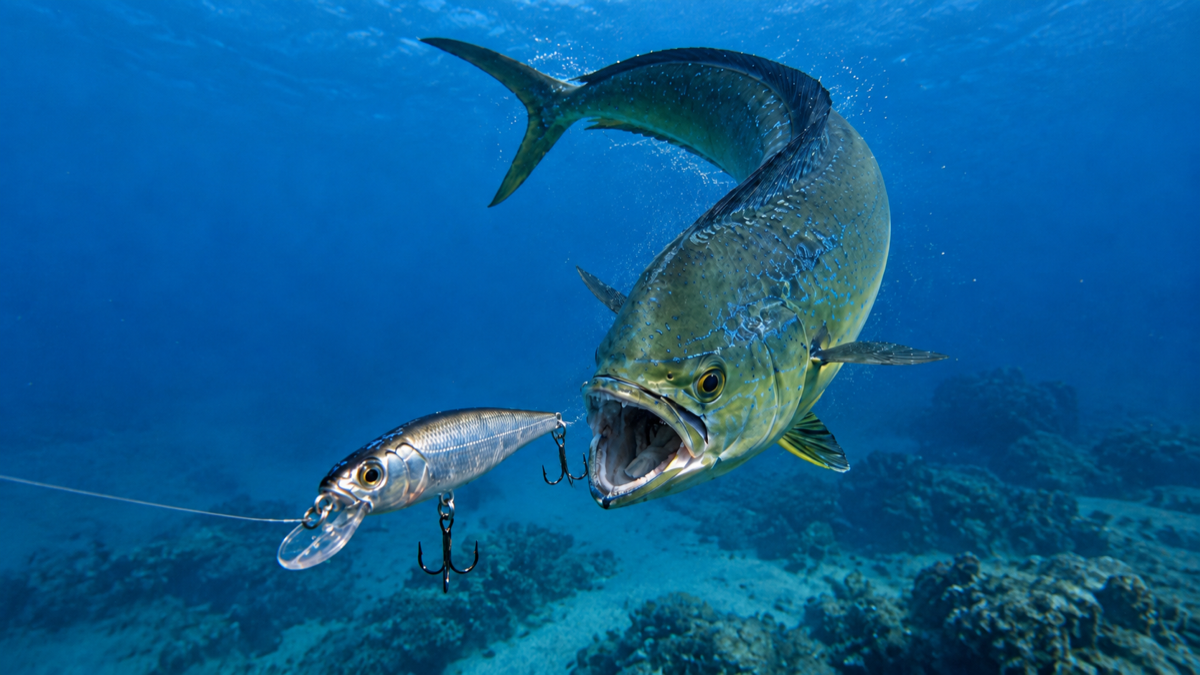
At that precise moment, the skipper should put the engine into neutral, and fellow anglers should grab light spinning rods (15-40g or 20-60g action) rigged with:
- Small poppers and floating stickbaits: Visual topwater strikes are second to none in excitement.
- Lead-headed soft plastics (15 to 30 grams): Highly effective if the fish become wary at the surface and drop a few meters below the keel.
- Light casting jigs: For long casts if the school starts drifting away.
As long as you keep one fish swimming in the water, the school will stay under the boat. As soon as you bring the last mahi-mahi aboard, the school typically disperses within seconds.
Why an Open-Water Waypoint is Pure Gold: Shattering the Luck Myth
Many anglers think: "If mahi-mahi swim in the open sea and are constantly moving, what good is saving a GPS point?".
This is one of the biggest conceptual mistakes in sportfishing. Mahi-mahi do not wander at random across an empty ocean:
- Dominant currents channel along the same bathymetric contours: If a drop-off transitioning from 80 to 150 meters routinely creates an upwelling current carrying nutrients to the surface, mahi-mahi will patrol that exact line year after year when water temperatures are favorable.
- Fixed buoys and offshore installations stay in place: Many fish farms, weather buoys, or deep-sea moorings are permanent structures that hold schools of mahi-mahi throughout the entire season.
- Current convergence zones recur: Specific capes, coastal points, and islands generate persistent current eddies at very specific geographic coordinates.
If you find an active school 4 miles offshore, rely solely on memory, and head home thinking "I'll remember where it was", ten months later you will return to sea only to realize that "out there" represents 50 square kilometers of identical-looking water.
With CAPTA, the instant that first strike occurs, you tap a button and record the exact waypoint. You can label it Mahi-Mahi – Active School Trolling – 6 knots and link it directly to your personal fishing log.
Don't Just Save the Spot: Save the Marine Conditions
A coordinate at sea is an empty coordinate if you don't know what was happening in the environment at the moment of the catch.
Imagine that on September 18th last year you enjoyed an epic day with 8 solid mahi-mahi. You return to the exact same waypoint on September 18th this year and the sea looks like a desert. Has the spot gone dead? No. What changed was the environmental context:
- Perhaps last year the water was 24.5 °C, while this year an easterly gale cooled the surface layer to 20 °C.
- Perhaps last year a gentle southerly breeze pushed the current seam against the shelf, whereas today there is a dead calm with zero water movement.
- Perhaps the moon phase and tidal current were completely different.
That is why CAPTA is not just a simple map viewer: when you save a waypoint, the app automatically logs the meteorological and marine conditions associated with that exact moment: water temperature, wind speed and direction, barometric pressure, and moon phase.
This way, as the next season approaches and weather patterns realign, CAPTA lets you review your history to know when and where ideal circumstances repeat. You stop guessing and start fishing with your own hard data.
Complete Step-by-Step Strategy for the Fishing Day
To achieve systematic success when targeting mahi-mahi, follow this tactical protocol:
- Pre-trip Sea Surface Temperature (SST) check: Locate thermal breaks and pools of warm water before leaving port.
- Route planning: Plot a course that crosses depth contours perpendicularly between 50 and 150 meters.
- Setting the trolling spread: Upon crossing 40-50 meters of depth, deploy 4 lines at 5.5 to 6.5 knots, alternating feathers and minnows.
- Active visual watch: Keep binoculars or sharp eyes scanning for diving birds, color slicks, or floating debris.
- Cautious approach to floating flotsam: If you spot a log or buoy, ease down to 4 knots and circle the obstacle at a safe distance.
- Save the waypoint on first strike: As soon as the reel screams, tap save in CAPTA so you don't lose the school's geographic position.
- Shift into neutral and hold the catch in the water: Bring the mahi-mahi alongside the boat but keep it in the water to serve as a live decoy for the rest of the school.
- Lightning transition to spinning: Cast small poppers or soft plastics right behind the hooked fish to trigger instant strikes from the group.
- Log the catch details: Add photos of the catch, the lure used, and tactical notes to the waypoint in CAPTA.
- Review history for the next tide: Use your accumulated data to plan your outings for upcoming weekends.
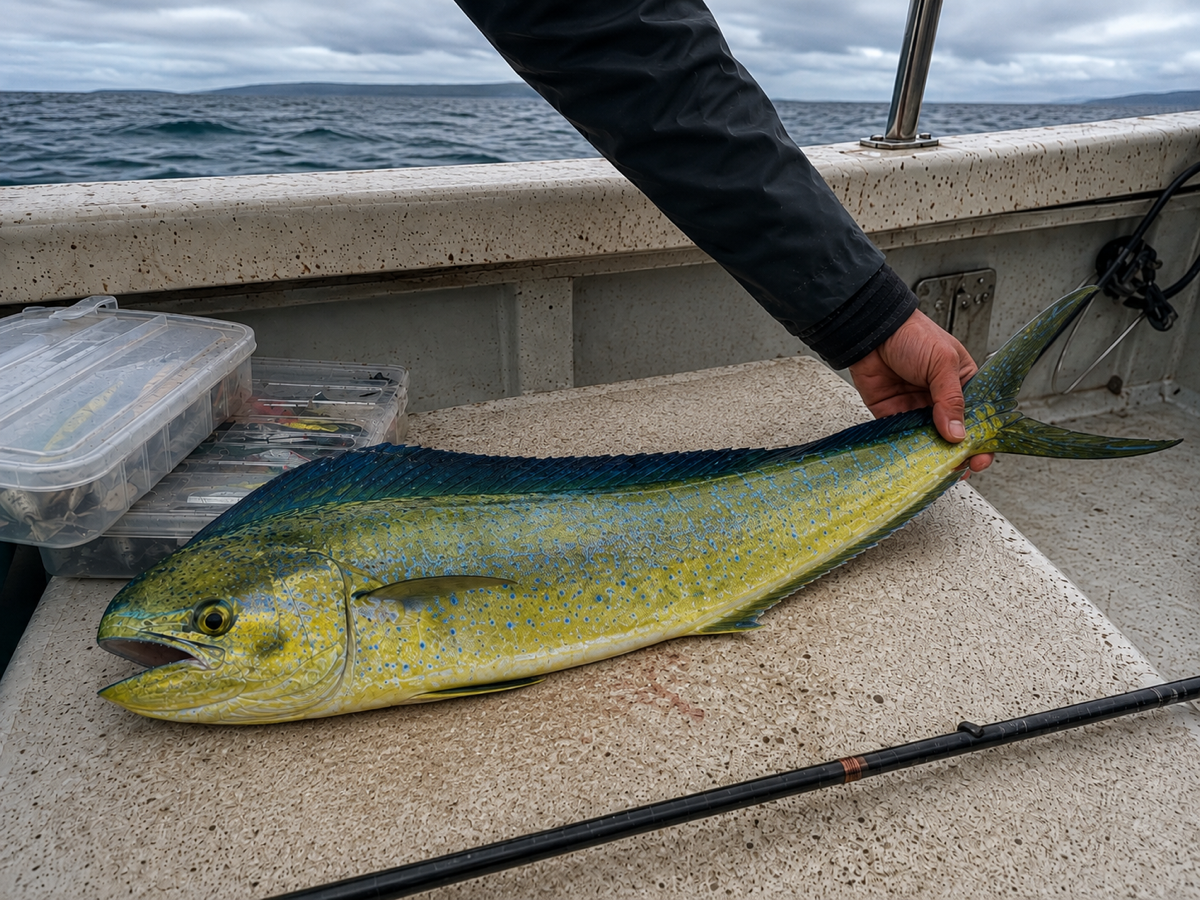
Protect Your Marks Without Relying on a Single Plotter
Many anglers store the greatest moments of their fishing lives on the internal memory of their boat's chartplotter or sounder. But marine electronics are exposed to constant hazards:
- Failures caused by humidity, condensation, or voltage spikes from boat batteries.
- Screen replacements or brand switches (from Garmin to Lowrance, Simrad, or Raymarine) with incompatible proprietary file formats.
- Selling the boat or fishing aboard a friend's vessel where you don't have access to your personal marks.
Your fishing marks are the result of burned fuel, early alarms, and hard-earned sea experience. They should never depend solely on a single hardware screen.
With CAPTA, you maintain a secure, private backup right in your pocket. Thanks to GPX file import and export, you can transfer your waypoints between your phone and any chartplotter on the market in seconds. Your private spots remain yours, no matter what happens to the boat or the electronics.
Frequently Asked Questions (FAQ)
What speed should I troll to catch mahi-mahi?
The most productive trolling speed for mahi-mahi is between 5 and 7 knots. Unlike bottom species that require slow, deliberate presentations, the mahi-mahi is an extremely fast predator that hunts based on visual and vibrational triggers. At these speeds, feathers and surface lures create an attractive bubble trail that perfectly mimics baitfish fleeing at full speed.
Why do mahi-mahi concentrate under floating objects?
Mahi-mahi exhibit a behavior known as positive thigmotropism, which compels them to seek shelter and shade under any structure drifting in open water. Beyond providing shade from the sun, these floating objects accumulate algae, small crustaceans, and fry, creating an ephemeral micro-ecosystem where mahi-mahi find abundant prey that is easy to ambush.
What are the best lures for trolling and spinning for mahi-mahi?
For trolling, the most proven lures are perforated jet-head feathers, small vinyl squids (8 to 12 cm) in white, pink, or blue, and shallow-running minnows. For light spinning when the school is gathered under the boat, small poppers (10 to 14 cm) and natural-colored leaded soft plastic shads trigger explosive visual strikes.
What time of year are mahi-mahi most abundant along our coasts?
The mahi-mahi season spans primarily from late August to mid-November, peaking during September and October. During this window, surface waters reach optimal temperatures (above 22-24 °C) and fast-growing juveniles approach coastal shelves and islands before retreating offshore when the first cold winter storms arrive.
How does CAPTA help anticipate the mahi-mahi season?
CAPTA stores each catch with its exact GPS coordinates linked to the meteorological and oceanic conditions of the day (sea surface temperature, barometric pressure, wind, and moon phase). By logging your outings over time, the app helps you compare current forecasts with past successful conditions, pinpointing exactly when your seasonal window reopens.
Is it better to catch mahi-mahi by trolling or light spinning?
Both techniques complement each other perfectly and form parts of the same overarching strategy. Trolling is the ideal scouting tool to cruise fast and cover water until getting that first strike. Once the school is pinned down and the first fish is held alongside the boat, switching to light spinning with surface lures provides unmatched sport, direct connection, and visual excitement.
Recommended Articles
If you love chasing pelagic predators from boat or kayak, explore these technical guides from our blog: