There are fish that allow you to correct mistakes during the fight. The Greater Amberjack is usually not one of them. When a large Greater Amberjack (Seriola dumerili) takes a live bait near a rock, a wreck, or a steep drop-off, the first few seconds can decide practically everything.
The strike can be brutal and the first run, even more so. If the fish manages to reach a structure, the fight can be over before it has really begun.
Precisely for this reason, live bait fishing for Greater Amberjack combines some of the most addictive aspects of boat fishing: locating the right spot, getting good bait, presenting it correctly, controlling the drift, and being prepared for one of the most violent strikes we can encounter.
But there is another part of this fishing that often receives less attention. Remembering exactly where and under what conditions we found the amberjacks.
Because a rock that produced a great catch last year can be interesting again. A certain drift can work again. And specific wind, sea, and weather conditions can reappear. That is where a simple waypoint begins to become something much more valuable.
The Greater Amberjack: Power, Speed, and Structure
The Greater Amberjack, also known as amberjack or pez limón in Spanish, belongs to the Carangidae family. It can reach truly significant sizes; in fact, FishBase records specimens up to 190 cm and 81 kg.
Adults are described as fish associated with deep reefs and outer zones, although they can occasionally approach bays and coastal waters. It is a highly prized species by sport fishermen. A study by the FAO describes it as a large pelagic predator and one of the most valued fishing resources.
But to catch it, there is one particularly important characteristic: it is a born predator. Adults feed mainly on fish, although they can also consume invertebrates.
This explains perfectly why presenting a live and vulnerable prey in an area where we know amberjacks patrol can be so effective. Just as with techniques like live bait fishing for John Dory, we are not trying to convince the fish with something artificial. We are placing real food in front of a predator.
The First Secret of Live Bait Fishing is Not the Bait: It's the Spot
We can bring the best squid from the livewell. We can rig a perfect setup and control the depth precisely. But if there are no amberjacks below us, none of that matters.
That is why location is probably the most important part of the whole strategy. Large amberjacks are usually related to areas that concentrate life and food: isolated rocks, wrecks, shoals, steep drop-offs, cliffs, reefs, and deep structures.
And here appears a huge difference between going out to look for amberjacks for the first time and returning to an area we already know. The second time we shouldn't start from scratch.
Suppose one morning we find a rock at 55 meters. We make a first drift and nothing. We correct the entry, second drift and nothing. We slightly modify our position, third pass and the squid starts to get nervous. Seconds later the strike arrives and we catch an amberjack.
The usual thing is to save the position on the GPS and continue fishing. But in reality, we have learned much more than just coordinates. We know where we entered, where we drifted, in what part of the rock the strike occurred, and what depth we had. That is what we really should keep.
Your Best Amberjack Spots Are Worth Much More Than Coordinates
When we find a productive area we can immediately save it in CAPTA. For example: "Amberjack – rock 55 m". We can add photographs and our own notes about what happened.
But besides, CAPTA can associate the exact environmental conditions of that day to the waypoint. Thus, months later we do not depend solely on our memory. The point keeps its context intact.
Because remembering that we caught a great amberjack is usually easy. Remembering exactly how the wind, the sea, or the pressure was that morning is not so much anymore. And after several seasons, it becomes practically impossible.
Live Bait: Presenting Real Prey
Once the area is located, the second part of the strategy begins: getting and keeping good bait. Depending on the place and the applicable regulations, different species of live bait can be used.
But one of the most appreciated baits to look for large predators is the live squid. A healthy squid produces movement, changes color, moves, and reacts to the presence of a predator.
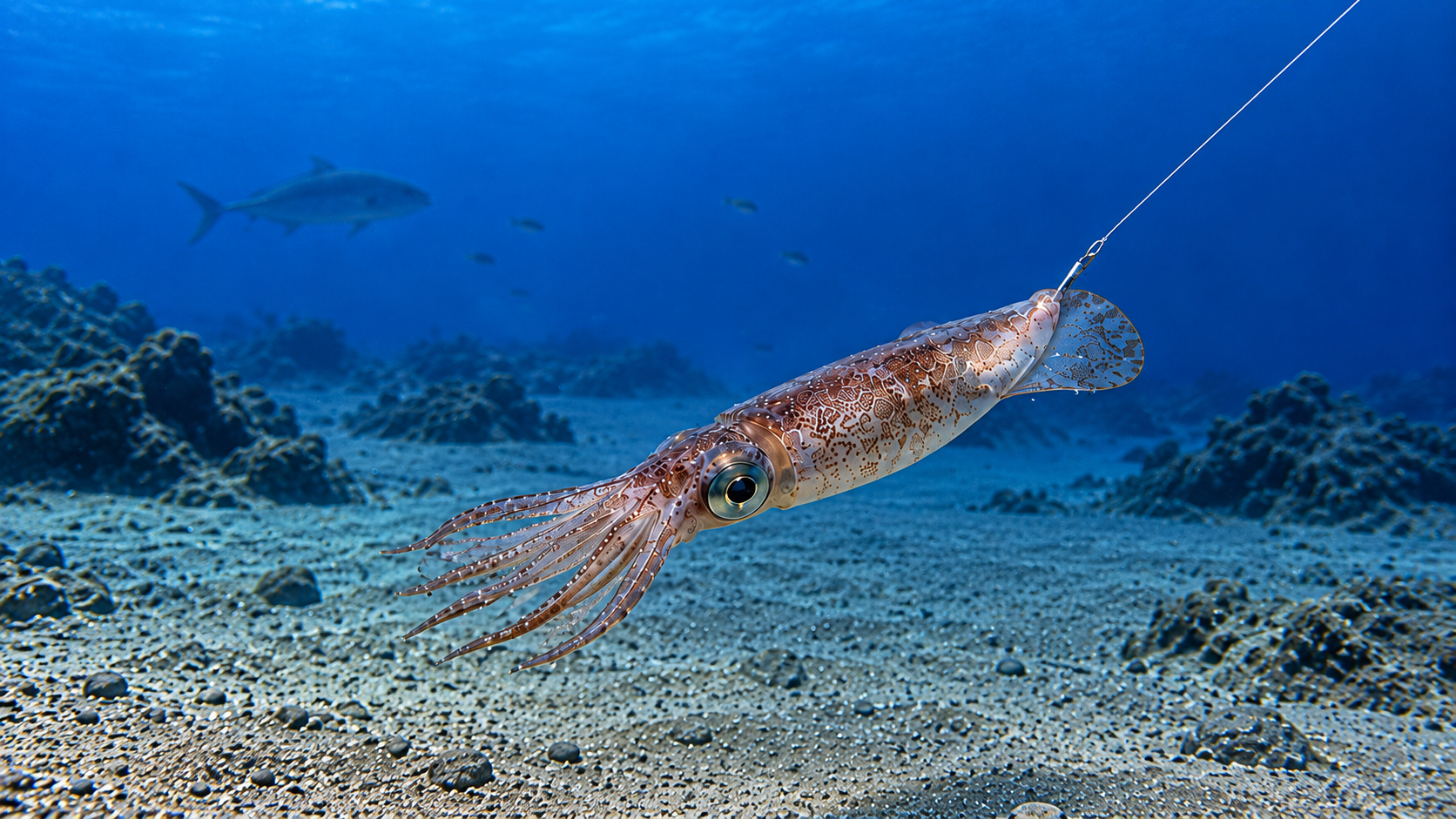
It transmits exactly what we want to present: a real prey. The goal is not simply to drop the bait, but for it to reach the fishing area in good condition and keep natural mobility.
A practically dead squid can still produce an occasional catch, but an active bait offers us something that no artificial lure can reproduce.
The Bait's Reaction Can Warn Us Before the Rod
This is one of the most exciting situations of live bait fishing. We are fishing. Apparently nothing happens. And suddenly the bait changes its behavior.
It starts to move violently and the line transmits small tugs. We know that something below has changed; on many occasions the squid has detected the predator before we even know it is there.
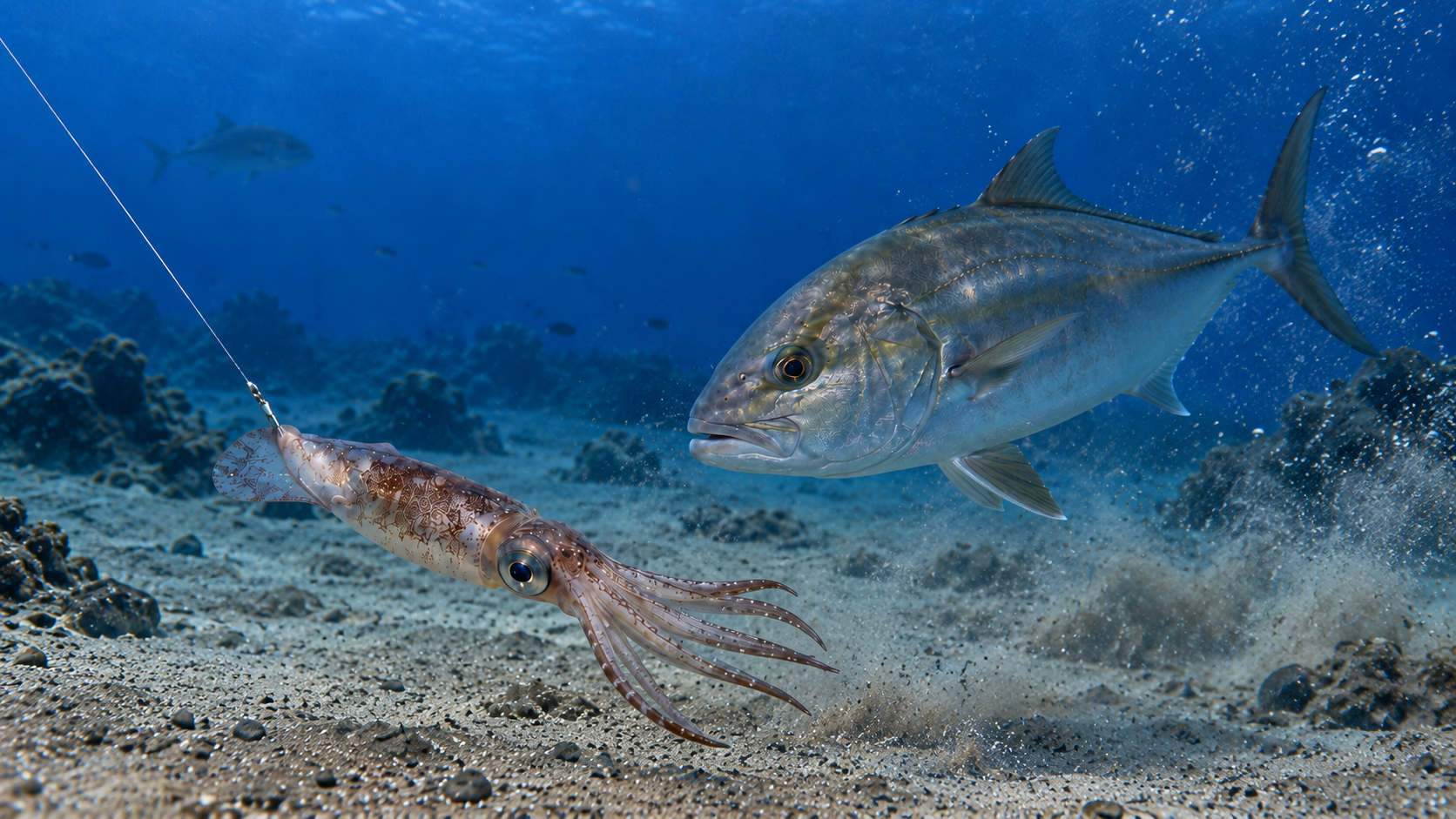
An amberjack can approach, observe, accompany for a few moments, and finally attack. And those seconds are precisely what justifies all the previous preparation. Hours looking for bait, miles navigating, and several drifts, everything can be resolved in a few seconds.
How to Present Live Bait Correctly
There is no single valid configuration for all situations. Depth, current, drift, bait size, and fish position force us to continuously adapt the presentation.
But the principle is always similar: the bait has to pass where the amberjacks are hunting. Not ten meters above if they are stuck to the bottom. Not behind the rock if they patrol the current face. Whether looking for specimens on the bottom or trying amberjack jigging, understanding their position is vital.
This is one of the reasons why live bait fishing demands much more than dropping a line. You have to continuously control the boat's position, the drift, the depth, and the path we want to take over our waypoint.
The Correct Drift Can Be More Important Than Repeating the Spot
Imagine a relatively small rock of which we have marked its center. If we simply navigate to those coordinates and drop the bait, we can pass completely outside the productive zone.
Why? Because the boat moves, the wind pushes, and the current displaces. Our bait also acquires its own angle underwater. That is why the waypoint must be interpreted as a reference around which to build the drift. Not necessarily as the exact point where we have to stop the boat.
We can enter before, let the live bait work, cross the area, exit, and repeat. After several strikes we may discover that the amberjacks always attack on a certain face of the structure. Then we will have discovered how to fish that spot.
Selecting our waypoint and navigating towards it with CAPTA, we have the exact heading and distance on the mobile. We no longer have to mentally remember where that rock was where we got the amberjack two seasons ago. We look for it in our history and prepare the perfect drift.
When the Amberjack Arrives, Everything Happens Very Fast
The scene can seem calm. A suspended squid. A slow drift. Nothing around. Until, suddenly, a large shadow appears on the sonar.
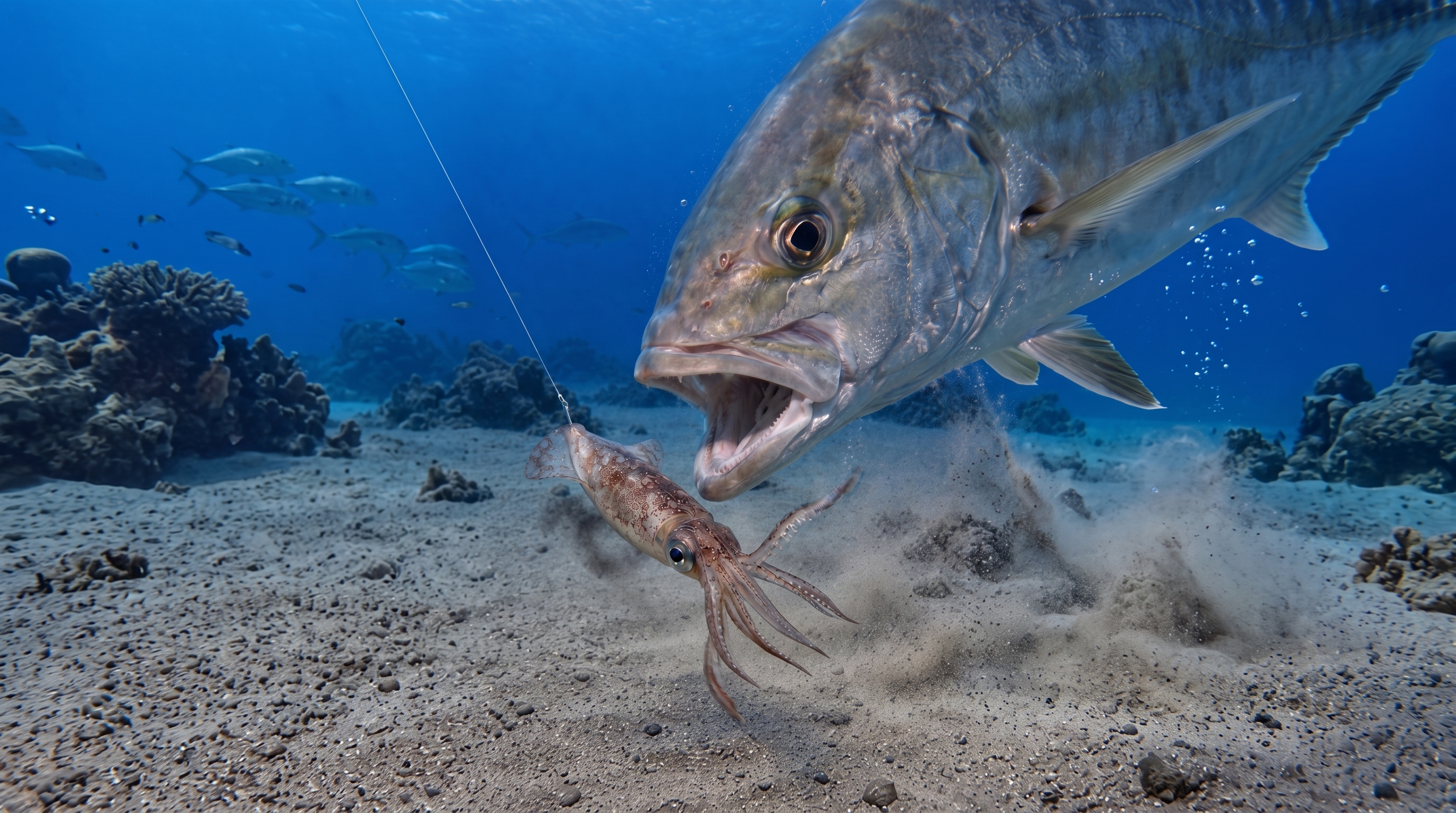
The amberjack accelerates and takes the bait. Then the truly violent part begins. A large amberjack has enough power to quickly take us towards the structure.
That is why it is advisable to have the equipment ready before the strike occurs. The drag, the rod, the line, and the terminal must be ready to withstand the first run. Every meter the fish manages to gain can bring it closer to an area where it can cut the line beyond repair.
The Most Expensive Mistake: Enjoying the Catch and Forgetting to Save What's Important
Finally we manage to separate it from the bottom. After a powerful fight it appears under the boat, rises, and we manage to board our amberjack.
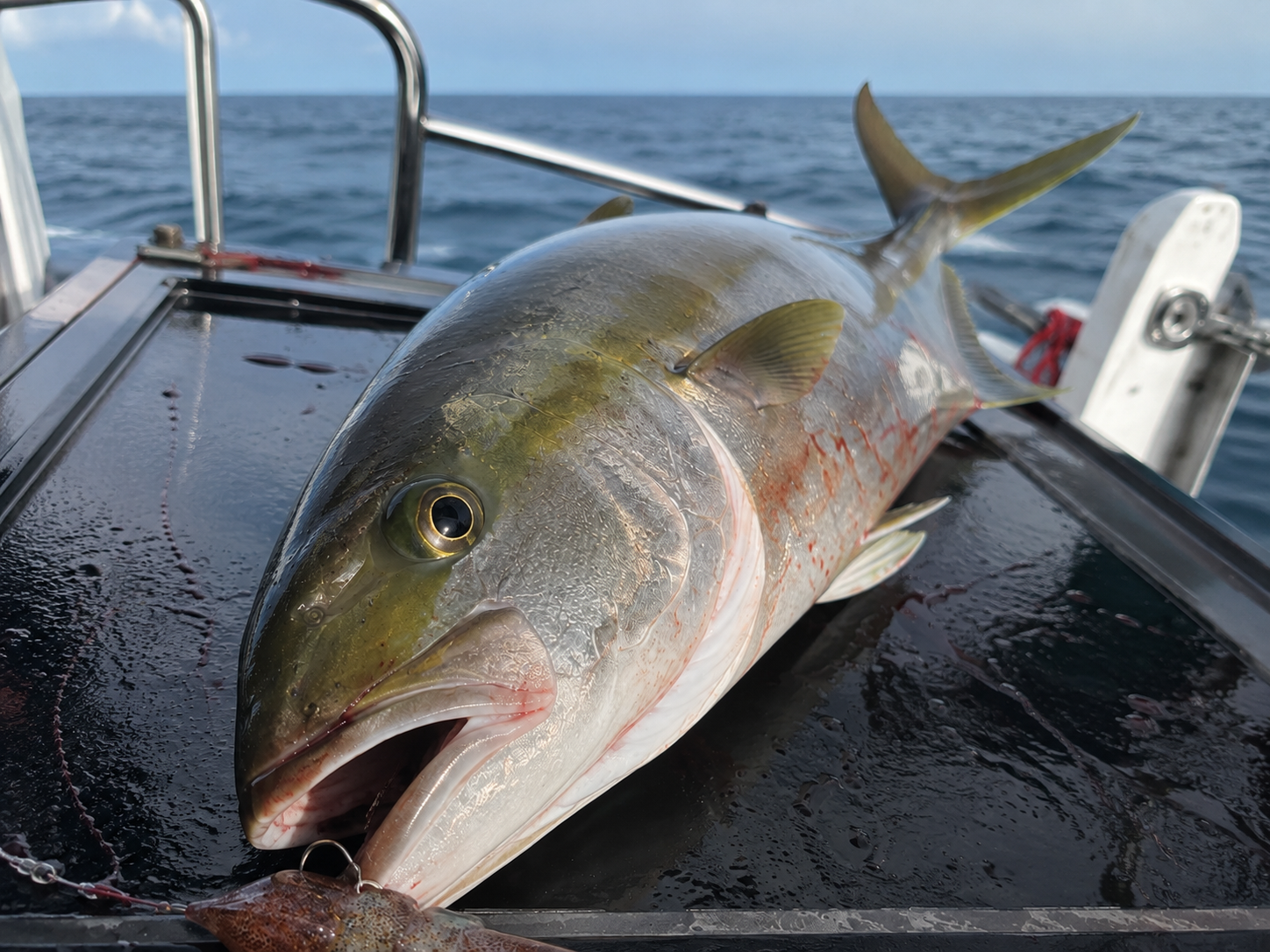
That moment will probably end up in our photo gallery, but it should also end up in our fishing history. We have just obtained one of the hardest pieces of information to get: we know that an amberjack was hunting there.
We save the spot, the time, the depth, and the type of bait. And we let CAPTA also keep the conditions associated with the place and that day. Then the photograph reminds us of the fish, but the waypoint reminds us how we got to it.
The Next Season Starts Today
Here is probably one of the biggest advantages of correctly recording our catches. Today we think we will remember everything. In twelve months we will probably remember enough. In five years, no.
We will have new rocks, new catches, new boats, and dozens of days mixed in our memory. CAPTA allows us to build a history that grows season after season, stopping us from starting from scratch every year.
When conditions similar to those we associate with that spot approach again, CAPTA's alerts can help us remember that it is worth paying attention to that place again.
It doesn't mean that magically "tomorrow there will be an amberjack there". It means that "the conditions are similar again to those you had when this point worked". The decision is still the fisherman's, but now it is also based on their own history converted into data. CAPTA simply helps to preserve it.
Frequently Asked Questions (FAQ)
What is the best live bait for catching Greater Amberjack?
It depends hugely on the fishing area, seasonal availability, and the local regulations of each region. Baitfish (like mackerel, scad, or barracuda) and cephalopods form an essential part of the adult amberjack's natural diet, so different presentations can be very effective. However, live squid is almost unanimously considered one of the best possible baits when available, thanks to its erratic mobility and constant color changes when detecting threats underwater. By regularly recording your catches with CAPTA, you will be able to easily analyze at the end of the season exactly which species of bait has given you the largest amberjacks throughout the months.
Where is it best to look for Greater Amberjacks from a boat?
Adult specimens are usually strongly associated with deep reefs and abrupt outer structures, although at certain times of the year they can also patrol shallower coastal waters. Isolated rocks, sunken wrecks, underwater shoals, steep cliffs, and any transit area where abundant pelagic food concentrates are places worth thoroughly investigating. Meticulously saving each of these terrain variations as waypoints in your history will allow you to establish logical, repeatable, and highly efficient fishing routes.
At what depth does the Greater Amberjack usually live?
This species has an exceptionally wide range of habitability and is very tolerant to water pressure changes. Although records have been documented ranging from the very surface down to almost 400 meters deep, it is much more common to locate them actively hunting in intervals of between 20 and 80 meters. The exact fishing depth will depend hugely on the geographic area, surface water temperature, and the time of year we are in. Using CAPTA's automatic condition recording will definitively help you identify which bathymetric range the amberjacks in your area usually move in month by month.
Why is it so important to control the drift when live bait fishing?
Knowing the exact coordinates of a productive rock does not in any way guarantee that your live bait will actually pass through the predators' hunting zone. Variable elements such as wind strength, dominant swell, and ocean currents constantly displace the boat on the surface, dragging your line away from the desired structure on the bottom. For this reason, you must carefully calculate your entry point so that the natural drift presents the live bait perfectly and temptingly over the hot zone. Noting and classifying your most successful drift angles in your waypoints will save you a lot of time and fuel in the future.
Is there any point in saving a waypoint after boarding the catch?
It is absolutely fundamental, as it allows you to return later with surgical precision to the exact area where the attack occurred to try and repeat the drift pass. In addition, by immediately saving the position along with key data such as exact depth, date, moon phase, and the type of bait used, you transform a blind spot into a historical record of extremely high value. If you add to this the automatic recording of environmental variables, the waypoint automatically becomes a powerful predictive tool to plan your next trips out to sea.
Does CAPTA work like a radar that tells me where the amberjacks are?
No, the CAPTA application does not magically predict the exact location of fish schools nor does it function as an expensive real-time echo sounder. Its true and authentic value lies in organizing your own spots and your personal catch history privately, intelligently, and safely over time. It allows you to easily return to previously saved positions and relate them to the exact climatic conditions at the time of the catch, thus helping you to recognize success patterns that have worked for you in the past.
Is it worth noting the weather conditions of each catch?
Yes, without a doubt. Over the years and after hundreds of accumulated fishing trips, it becomes humanly impossible to remember exactly what temperature, wind, or atmospheric pressure accompanied each successful day. Directly associating each of your productive spots with this environmental context allows you to quickly compare different catches and detect recurring patterns in fish behavior throughout the different seasons. Precisely for this important reason, delegating the recording of these variables to a specialized application completely makes the difference between fishing by blind intuition or fishing by real knowledge.
Can I use CAPTA if I already have a chartplotter and a good sonar on the boat?
Of course you can; in fact, they are technological tools that complement each other perfectly throughout the fishing day at sea. CAPTA allows you at all times to keep all your valuable waypoints organized, private, secure, and always available in your pocket, preventing your fishing history from depending solely on the physical electronics installed on a specific boat. In addition, its full compatibility with GPX format files greatly facilitates the mass import and export of points so that all your accumulated knowledge always accompanies you, whether you change boats regularly or decide to upgrade your navigation equipment on board.